
Plot the interaction in a single-equation time series model estimated via lm.
Source: R/tseffects.R
interact.adl.plot.RdPlot the interaction in a single-equation time series model estimated via lm.
Usage
interact.adl.plot(
  model = NULL,
  x.vrbl = NULL,
  z.vrbl = NULL,
  x.z.vrbl = NULL,
  y.vrbl = NULL,
  shock.history = "impulse",
  plot.type = "lines",
  line.options = "z.lines",
  heatmap.options = "significant",
  line.colors = "okabe-ito",
  heatmap.colors = "Blue-Red",
  z.vals = NULL,
  s.vals = c(0, "LRM"),
  z.label.rounding = 3,
  z.vrbl.label = names(z.vrbl)[1],
  dM.level = 0.95,
  s.limit = 20,
  se.type = "const",
  return.data = FALSE,
  return.plot = TRUE,
  return.formulae = FALSE,
  ...
)
Arguments
- model
the
lmmodel containing the ADL estimates- x.vrbl
named numeric vector of the “main” x variables and corresponding lag orders in the ADL model
- z.vrbl
named numeric vector of the “moderating” z variables and corresponding lag orders in the ADL model
- x.z.vrbl
named numeric vector with the interaction variables and corresponding lag orders in the ADL model. IMPORTANT: enter the lag order that pertains to the “main” x variable. For instance, x_l_1_z (contemporaneous x times lagged z) would be 0 and l_1_x_z (lagged x times contemporaneous z) would be 1
- y.vrbl
named numeric vector of the (lagged) y variables and corresponding lag orders in the ADL model. Can be
NULLif the model has no lagged dependent variables- shock.history
whether impulse/pulse or cumulative/step effects should be calculated.
impulse(orpulse) generates impulse effects (the Impulse Response Function), or short-run/instantaneous effects specific to each period.cumulative(orstep: the Step Response Function) generates the accumulated, or long-run/cumulative effects up to each period (including the long-run multiplier). The default isimpulse- plot.type
a string for whether to feature marginal effects at discrete values of s/z as
lines, or across a range of values through aheatmap. The default islines- line.options
if drawing lines, a string for whether the moderator should be values of z (
z.lines) or values of s (s.lines). The default isz.lines- heatmap.options
if drawing a heatmap, a string for whether
allmarginal effects should be shown or just statistically significant ones. (Note: this just sets the insignificant effects to the numeric value of 0. If the middle value of your scale gradient is white, these will effectively “disappear.” If another gradient is used, they will take on the color assigned to 0 values.) The default issignificant- line.colors
a string for what color lines would you like for line plots? This defaults to the color-safe Okabe-Ito (
okabe-ito) colors. There is also a grayscale option throughbw. Users can also include whatever colors they like. The number of colors must match the number of lines drawn. This is passed toscale_color_discrete- heatmap.colors
a string for what color scale would you like for the heatmap? The default is
Blue-Red. Alternate colors must be one ofhcl.pals(). For grayscale plots, useGrays. This is passed toscale_fill_gradientn- z.vals
numeric values for the moderating variable. If
plot.type = lines, these are treated as discrete levels of z. Ifplot.type = heatmap, these are treated as a lower and upper level of a range of values of z. If none are provided,interact.adl.plotwill pick- s.vals
numeric values for the time since the shock. This is only used if
line.options = s.lines, meaning s is treated as the moderator. The default is 0 (short-run) and theLRM- z.label.rounding
number of digits to round to for the z labels in the legend (if those values are automatically calculated)
- z.vrbl.label
the name of the moderating z variable, used in plotting
- dM.level
significance level of the (cumulative) marginal effects, calculated by the delta method. The default is 0.95
- s.limit
an integer for the number of periods to determine the (cumulative) marginal effects (beginning at s = 0)
- se.type
the type of standard error to extract from the model. The default is
const, but any argument tovcovHCfrom thesandwichpackage is accepted- return.data
logical to return the raw calculated (cumulative) marginal effects as a list element under
estimates. The default isFALSE- return.plot
logical to return the visualized (cumulative) marginal effects as a list element under
plot. The default isTRUE- return.formulae
logical to return the formulae for the (cumulative) marginal effects as a list element under
formulae(for the (cumulative) marginal effects) andbinomials(for the shock history). The default isFALSE- ...
other arguments to be passed to the call to plot
Value
depending on return.data, return.plot, and return.formulae, a list of elements relating to the interaction
Details
We assume that the ADL model estimated is well specified, free of residual autocorrelation, balanced, and meets other standard time-series qualities. It is imperative that you double-check you have referenced all x, y, z, and interaction terms through x.vrbl, y.vrbl, z.vrbl, and x.z.vrbl. You must also have their orders correctly entered. interact.adl.plot has no way of determining, from the variable list, which correspond with which
Examples
# Using Cavari's (2019) approval model
# Cavari's original model: APPROVE ~ APPROVE_ECONOMY + APPROVE_FOREIGN + MIP_MACROECONOMICS +
# MIP_FOREIGN + APPROVE_ECONOMY*MIP_MACROECONOMICS + APPROVE_FOREIGN*MIP_FOREIGN +
# APPROVE_L1 + PARTY_IN + PARTY_OUT + UNRATE +
# DIVIDEDGOV + ELECTION + HONEYMOON + as.factor(PRESIDENT)
approval$ECONAPP_ECONMIP <- approval$APPROVE_ECONOMY*approval$MIP_MACROECONOMICS
approval$FPAPP_ECONFP <- approval$APPROVE_FOREIGN*approval$MIP_FOREIGN
cavari.model <- lm(APPROVE ~ APPROVE_ECONOMY + APPROVE_FOREIGN + MIP_MACROECONOMICS +
MIP_FOREIGN + ECONAPP_ECONMIP + FPAPP_ECONFP +
APPROVE_L1 + PARTY_IN + PARTY_OUT + UNRATE +
DIVIDEDGOV + ELECTION + HONEYMOON + as.factor(PRESIDENT), data = approval)
# Now: marginal effect of X at different levels of Z
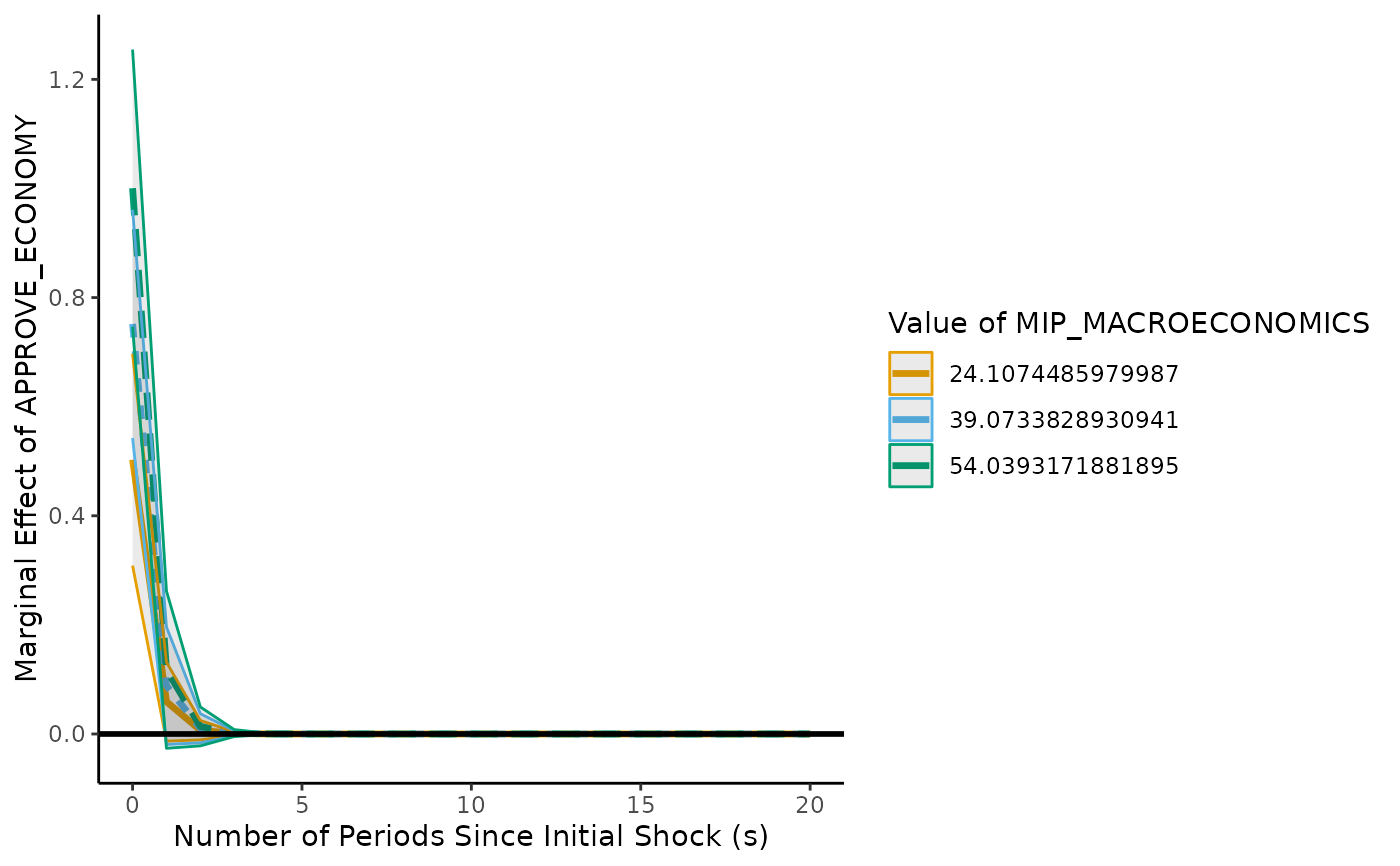
interact.adl.plot(model = cavari.model,
x.vrbl = c("APPROVE_ECONOMY" = 0), y.vrbl = c("APPROVE_L1" = 1),
z.vrbl = c("MIP_MACROECONOMICS" = 0), x.z.vrbl = c("ECONAPP_ECONMIP" = 0),
shock.history = "impulse", plot.type = "lines", line.options = "z.lines")
#> Warning: Variable names containing . replaced with _
#> Warning: Variable names containing ( replaced with _
#> Warning: Variable names containing ) replaced with _
 # Use well-behaved simulated data (included) for even more examples,
# using the Warner, Vande Kamp, and Jordan general model
model.toydata <- lm(y ~ l_1_y + x + l_1_x + z + l_1_z +
x_z + z_l_1_x +
x_l_1_z + l_1_x_l_1_z, data = toy.ts.interaction.data)
# Marginal effect of z (not run: computational time)
# Be sure to specify x.z.vrbl orders with respect to x term
if (FALSE) interact.adl.plot(model = model.toydata, x.vrbl = c("x" = 0, "l_1_x" = 1),
y.vrbl = c("l_1_y" = 1), z.vrbl = c("z" = 0, "l_1_z" = 1),
x.z.vrbl = c("x_z" = 0, "z_l_1_x" = 1,
"x_l_1_z" = 0, "l_1_x_l_1_z" = 1),
z.vals = -2:2,
shock.history = "impulse",
plot.type = "lines",
line.options = "z.lines",
s.limit = 20)
# \dontrun{}
# Heatmap of marginal effects, since X and Z are actually continuous
# (not run: computational time)
if (FALSE) interact.adl.plot(model = model.toydata, x.vrbl = c("x" = 0, "l_1_x" = 1),
y.vrbl = c("l_1_y" = 1), z.vrbl = c("z" = 0, "l_1_z" = 1),
x.z.vrbl = c("x_z" = 0, "z_l_1_x" = 1,
"x_l_1_z" = 0, "l_1_x_l_1_z" = 1),
z.vals = c(-2,2),
shock.history = "impulse",
plot.type = "heatmap",
heatmap.options = "all",
s.limit = 20)
# \dontrun{}
# Use well-behaved simulated data (included) for even more examples,
# using the Warner, Vande Kamp, and Jordan general model
model.toydata <- lm(y ~ l_1_y + x + l_1_x + z + l_1_z +
x_z + z_l_1_x +
x_l_1_z + l_1_x_l_1_z, data = toy.ts.interaction.data)
# Marginal effect of z (not run: computational time)
# Be sure to specify x.z.vrbl orders with respect to x term
if (FALSE) interact.adl.plot(model = model.toydata, x.vrbl = c("x" = 0, "l_1_x" = 1),
y.vrbl = c("l_1_y" = 1), z.vrbl = c("z" = 0, "l_1_z" = 1),
x.z.vrbl = c("x_z" = 0, "z_l_1_x" = 1,
"x_l_1_z" = 0, "l_1_x_l_1_z" = 1),
z.vals = -2:2,
shock.history = "impulse",
plot.type = "lines",
line.options = "z.lines",
s.limit = 20)
# \dontrun{}
# Heatmap of marginal effects, since X and Z are actually continuous
# (not run: computational time)
if (FALSE) interact.adl.plot(model = model.toydata, x.vrbl = c("x" = 0, "l_1_x" = 1),
y.vrbl = c("l_1_y" = 1), z.vrbl = c("z" = 0, "l_1_z" = 1),
x.z.vrbl = c("x_z" = 0, "z_l_1_x" = 1,
"x_l_1_z" = 0, "l_1_x_l_1_z" = 1),
z.vals = c(-2,2),
shock.history = "impulse",
plot.type = "heatmap",
heatmap.options = "all",
s.limit = 20)
# \dontrun{}