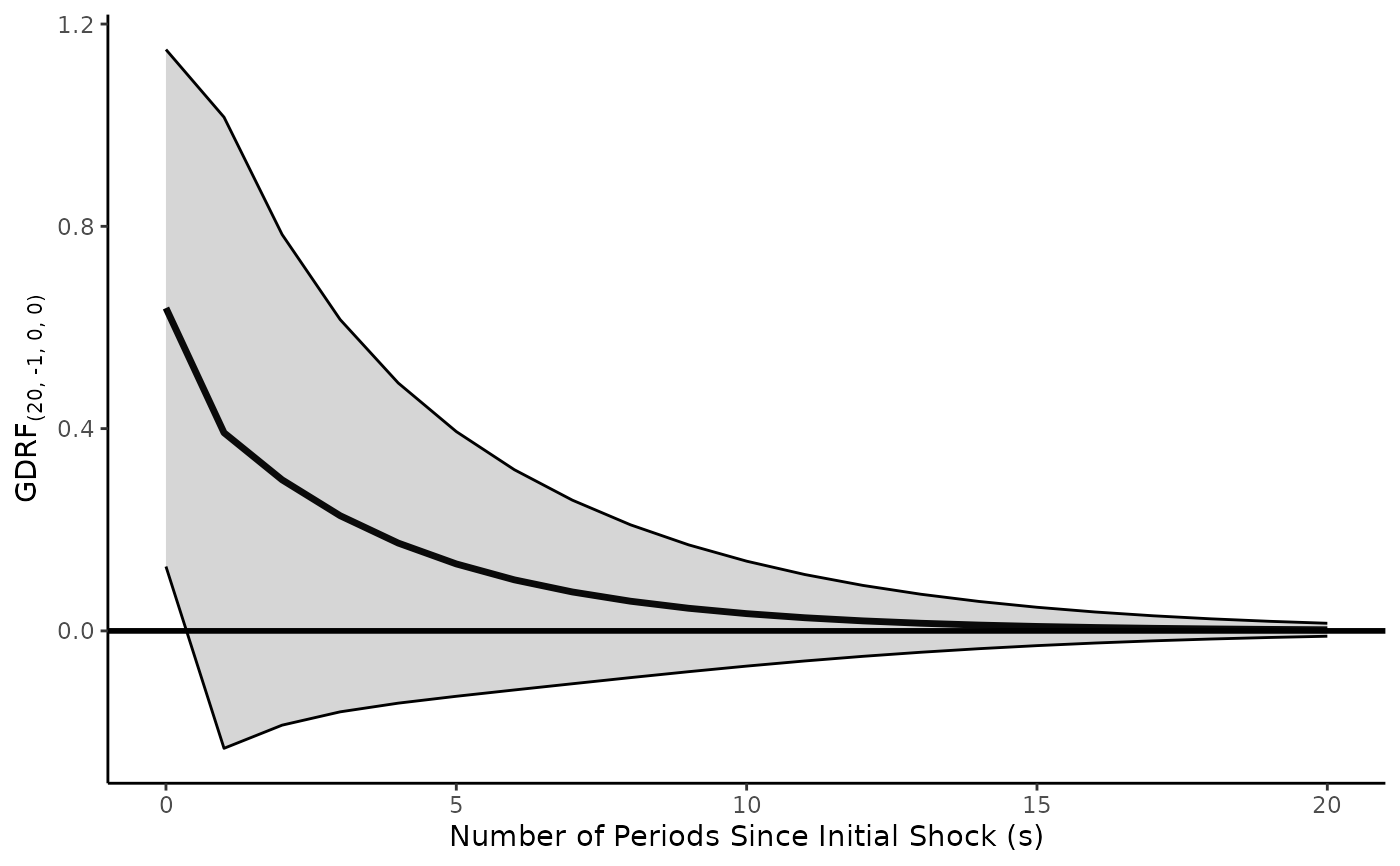
Evaluate (and possibly plot) the General Dynamic Response Function (GDRF) for an autoregressive distributed lag (ADL) model, assuming the underlying model is in levels (d.x = d.y = 0) and the user wants a marginal effect (the untransformed GDRF). (This is just a wrapper for GDRF.adl.plot with simplifying assumptions)
Source: R/tseffects.R
adl.plot.RdEvaluate (and possibly plot) the General Dynamic Response Function (GDRF) for an autoregressive distributed lag (ADL) model, assuming the underlying model is in levels (d.x = d.y = 0) and the user wants a marginal effect (the untransformed GDRF). (This is just a wrapper for GDRF.adl.plot with simplifying assumptions)
Usage
adl.plot(
  model = NULL,
  x.vrbl = NULL,
  y.vrbl = NULL,
  shock.history = "pulse",
  dM.level = 0.95,
  s.limit = 20,
  se.type = "const",
  return.data = FALSE,
  return.plot = TRUE,
  return.formulae = FALSE,
  ...
)
Arguments
- model
the
lmmodel containing the ADL estimates- x.vrbl
a named numeric vector in which the names correspond to an independent variable and its lags and the numbers correspond to the specific lag order of each variable
- y.vrbl
a named numeric vector in which the names correspond to lags of the dependent variable and the numbers correspond to the specific lag order of each variable. Can be
NULLif the model has no lagged dependent variables- shock.history
the desired shock history.
shock.historydetermines the shock history (h) (which can be expressed as an integer) that will be applied to the independent variable. -1 represents a pulse (Impulse Response Function). 0 represents a step (Step Response Function). These can also be specified viapulseandstep. For others, see Vande Kamp, Jordan, and Rajan. The default ispulse- dM.level
a numeric significance level of the GDRF, calculated by the delta method. The default is 0.95
- s.limit
an integer for the number of periods to determine the GDRF (beginning at s = 0)
- se.type
a string for the type of standard error to extract from the model. The default is
const, but any argument tovcovHCfrom thesandwichpackage is accepted- return.data
logical to return the raw calculated GDRFs as a list element under
estimates. The default isFALSE- return.plot
logical to return the visualized GDRFs as a list element under
plot. The default isTRUE- return.formulae
logical to return the formulae for the GDRFs as a list element under
formulae(for the GDRFs) andbinomials(for the shock history). The default isFALSE- ...
other arguments to be passed to the call to plot
Examples
# ADL(1,1)
# Use the toy data to run an ADL. No argument is made this is well specified; it is just expository
model.toydata <- lm(y ~ l_1_y + x + l_1_x, data = toy.ts.interaction.data)

# Since this is in levels, we can quickly look at the adl.plot
#  Pulse effect of x
adl.plot(model = model.toydata,
  x.vrbl = c("x" = 0, "l_1_x" = 1),
  y.vrbl = c("l_1_y" = 1),
  shock.history = "pulse",
  s.limit = 20)